


If you’ve ever handled a paper sewing pattern, you’ll know how flimsy they are. They’re tissue paper-thin and prone to crumpling or tearing as soon as you take them out of their envelope. However, the ephemeral nature of paper sewing patterns makes it easy to overlook its importance. Because without paper patterns, it’s arguable that none of us would be here* today.
(*talking, reading and sewing at home)
That’s because paper patterns were revolutionary for the home sewing industry. They opened the door to ordinary people, who, with the purchase of a sewing pattern, could now sew fashionable clothing without the need for years of training and elite technical expertise.

Hello, today’s post is an essay! I’ve adapted this from a small section in a recent essay that I wrote for a course in my MA in Fashion Cultures and Histories at the London College of Fashion.
If you enjoy this essay, please subscribe! I’m going to start posting an essay about something to do with fashion history or theory on every second weekend of the month. This is entirely motivated by the fact that I now have a ton of niche fashion history and theory knowledge that I want to share with you! If you’re not interested, there will still be loads of other sewing/sustainable fashion-related content the rest of the month xoxo
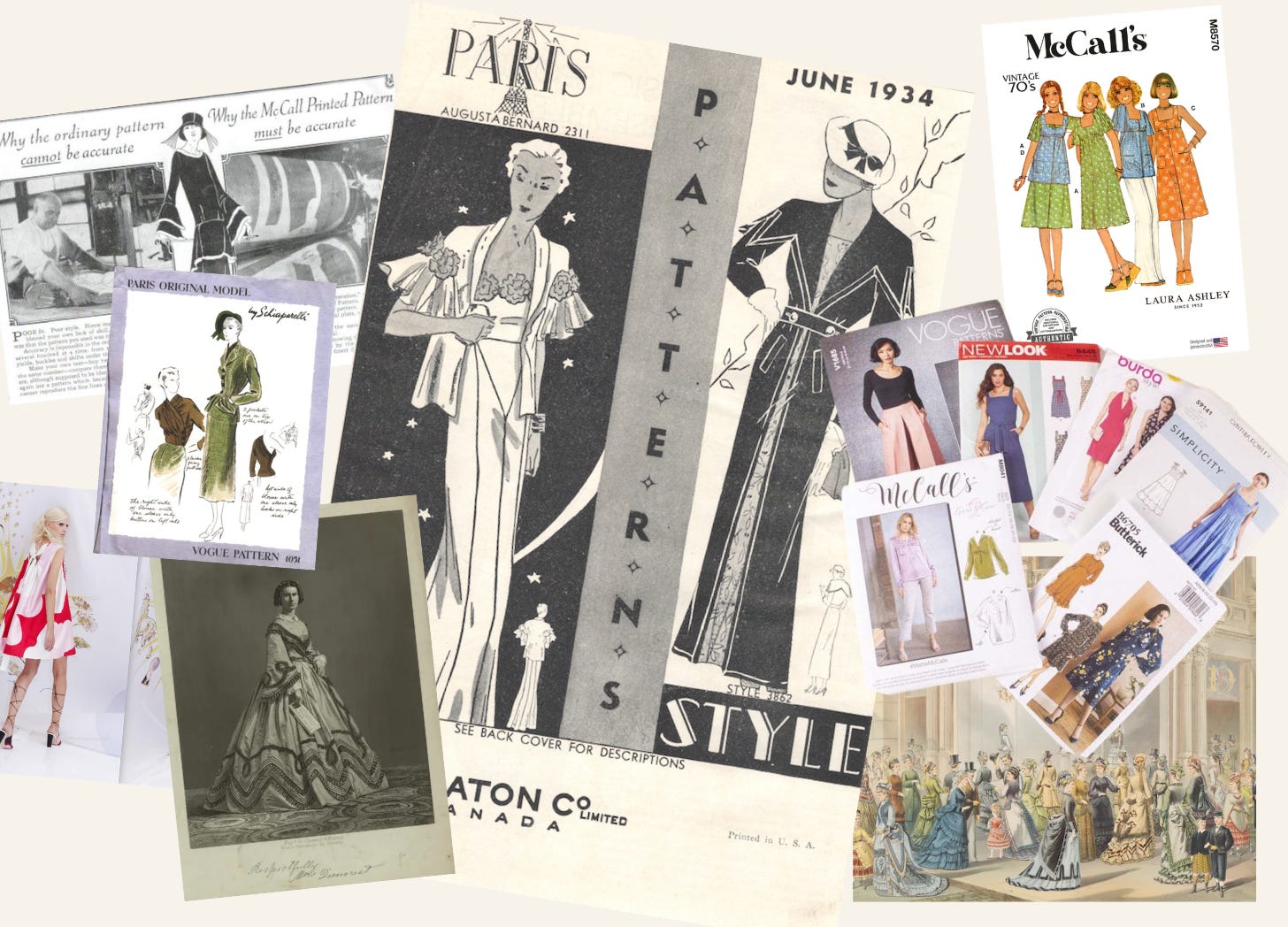
Before paper patterns, tailors had books
Patterns have existed a lot longer than you might imagine. However, not in the format most modern home sewists would be used to. That’s because the earliest recorded patterns were created by and for professional tailors.
The earliest surviving example of a sewing pattern is contained within the book Libro de geometria practica y traca (1580) by Spanish tailor Juan de Alcega. The book was a technical manual intended for trained craftspeople. Its purpose was to teach tailors how to cut pattern pieces in ways that produced the most garments possible from the least amount of fabric. This was especially important at a time when cloth was woven by hand and therefore very expensive.
Libro de geometria contains small diagrams of pattern pieces, very few measurements, and almost no written instructions. Without training, it would have been almost impossible to use. Similar texts followed across Europe over the next century; France had Le Tailleur Sincere in 1671, and England had The Tailor’s Complete Guide in 1769. All were written by tailors, for tailors, and assumed knowledge that could only be gained from years of making clothes. Patterns in the 17th and 18th centuries were very far from being a consumer-friendly product.
Additionally, patterns were often trade secrets. Good patterns were sometimes written into apprenticeship contracts or passed down from father to son like heirlooms. Well-fitting patterns were so enormously valuable because tailors and dressmakers had no standardised body measurements or drafting techniques. Most tailors and dressmakers relied on methods like ‘rock-of-eye’ drafting. This technique required them to draw pattern shapes freehand with chalk, mentally calculating proportions as they worked. Rock-of-eye was essentially drafting based on intuition developed through years of accumulated and inherited knowledge, which helps explain why tailors began training apprentices as early as ten.
In other words, patterns were knowledge, and knowledge was power.
From trade secret to teachable skill
By the late eighteenth century, tailoring knowledge began to loosen its grip. Some tailors started publishing drafting systems and teaching cutting techniques outside traditional apprenticeships, often to anyone who could pay. A London tailor named Dietrichstein reportedly sold pattern sets throughout England for the hefty price of £5 (around £600 today).
Around this period, drafting methods became more formalised. Alongside rock-of-eye drafting, the proportional drafting system emerged, which uses ratios based on key body measurements. There was also the direct measure system, which relies on specific measurements taken from an individual's body. These approaches made pattern drafting more systematic, more teachable and opened the door to non-tailors to draft their own clothes.
But this was still a world centred on professional men. There was no real commercialised home sewing market yet, and little reason to simplify patterns for untrained users. This would change in the nineteenth century.
Dressmaking, charity and the assumption of women’s skills
The first dressmaking patterns intended for non-professionals didn’t appear as fashion items. Instead, they arrived through charitable and moral publications. Books like Instructions for Cutting out Apparel for the Poor (1789) and The Ladies’ Economical Assistant (1808) provided patterns for basic garments — shirts, shifts and children’s clothing — aimed at women sewing for their families or for those in need.
These early patterns reveal an assumption that would persist for generations: women already knew how to sew. Instructions were sparse and often baffling by modern standards. Patterns were usually given in a single size, sometimes labelled simply by age. Details like linings, facings and fastenings were left out. The expectation being that a competent seamstress could fill in the gaps.
Importantly, these publications framed sewing as a moral good. Making clothes was positioned as thrift, charity and virtue. Butterick Pattern Co. continued pushing this narrative in their advertising, advising new brides in the 1860s with $1.00 to spend, to invest $0.50 in a Bible and $0.50 toward a good sewing machine.
Advice from Butterick Pattern Co. to newlyweds:
[y]oung men and ladies who are just sipping the sweets of connubial felicity, before you get a bedstead, purchase a sewing machine. If you can’t have both, sleep on the floor until you can earn enough with your sewing machine to pay for a bed-stead. Saw off halve a dozen pieces of maple boards for dinner plates, . . . [use] logs for seats. (Butterick Catalogue c.1869)
Technology changes everything
The mid-nineteenth century brought a perfect storm of changes that transformed sewing into a mass consumer activity.
First, the sewing machine dramatically reduced the time it took to make garments. Second, steam-driven paper-making machines began producing paper from wood pulp, making printing far cheaper. Additionally, improvements in postal services and printing technology meant magazines and paper inserts could be distributed widely and affordably.
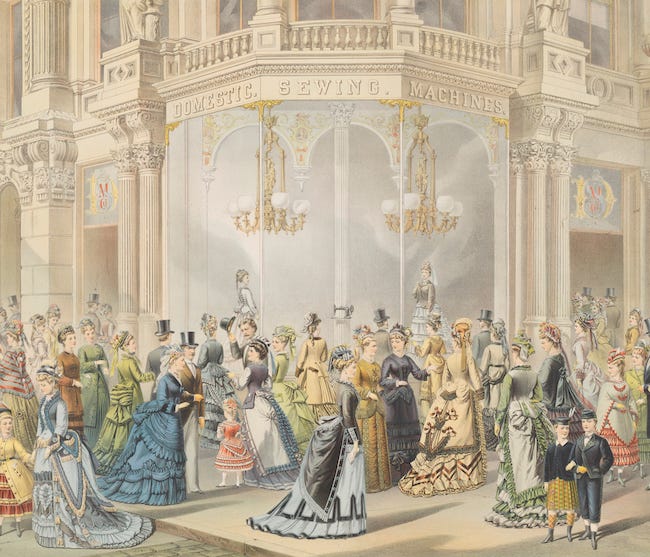
By the 1850s, fashion publications were booming. In 1854, Frank Leslie’s Gazette of Fashions began including fold-out patterns designed by Madame Demorest. While other publications had included patterns before, Madame Demorest was the first to truly brand herself as a patternmaker and sell patterns as individual products. She also ended up launching her own fashion magazine (Mme. Demorest’s Mirror of Fashions) to promote and sell her patterns, alongside opening Mme. Demorest's Emporium of Fashions.
There was, however, one significant oversight in the Demorests’ rise to success. In their drive to launch new ventures and continually innovate, they never took steps to patent Madame Demorest’s patternmaking methods. This left the door open for others to build on the idea — and it was this gap that set the stage for the next major development in the industry.
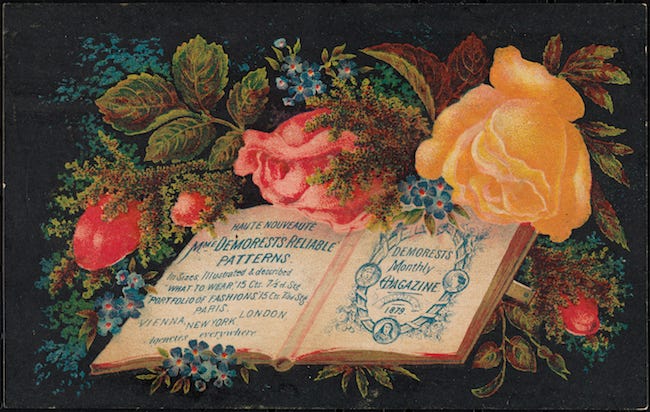
A brief interlude about Ellen Louise Curtis Demorest — a pioneer in patternmaking and champion of women’s rights
Madame Demorest was actually a husband and wife team — William J. Demorest and Ellen Louise Curtis Demorest.
However, Ellen wasn’t just Madame Demorest. She was an incredibly active part of the business, having come up with the initial idea to sell patterns. She was also a champion of women’s rights, including African-American women. At one point, she entered into a heated letter-writing exchange with The New York Times about “Women’s Work and Wages.” Her first Letter to the Editor opened with these pointed words:
“Inasmuch as you are not a woman, and do not, to any extent, employ women, allow one who is, and does, to reply…”
Ellen also used the Demorest magazine to publish writing by Louisa May Alcott, Julia Ward Howe, and the journalist Jane Cunningham Croly, who used her column to champion women’s accomplishments and causes.
Additionally, Ellen (alongside Joy Cunningham Croly) founded the first professional women’s club in New York, called Sorosis. At one of their meetings, she outlined how women’s lives were entirely dictated by their relationships to the men in their lives. Women are controlled by their fathers, and then husbands who have “claimed the monopoly of all money, personal property, &c. that marriage professedly makes of joint ownership”. Before concluding, in words as provocative as they were self-serving: “why wonder that she learns to smile at suggestions of extravagance in dress, and adds another yard to her train, or buys a more expensive set of lace for the next party, and sprinkles gold-dust over her glossy hair? She is none the poorer for the outlay, for ordinarily a wife owns only her own wardrobe.”
(Quotes sourced from Susan Johnson, “Madame” Demorest—The Woman at the Top of a 19-Century Fashion Empire)
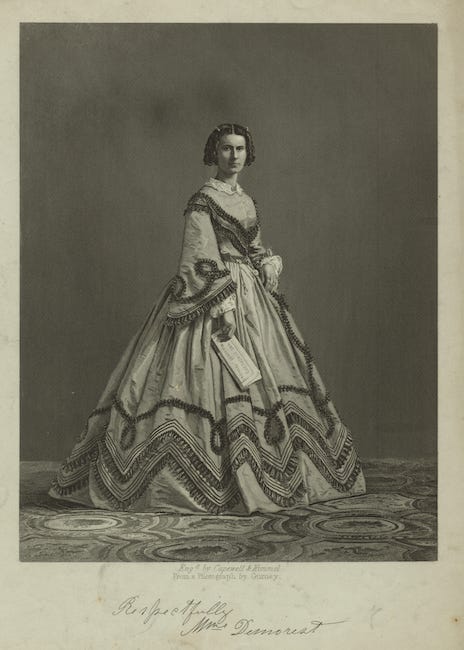
Ellen Demorest was far more than a patternmaker. She was a trailblazing businesswoman who used her position and privilege to champion not only other white women but also the people of colour she employed. Then, as now, the upper ranks of the fashion world (including the owners of major pattern companies) were largely dominated by men. That makes her presence at the very beginning of the home sewing industry all the more remarkable.
I sound slightly sycophantic, but considering the restrictions on women at the time, Ellen did lead an incredible life as a business owner and an advocate for women.
Graded sizes and the birth of the home sewing market
The real breakthrough in patternmaking came in the 1860s with Ebenezer Butterick.
Butterick’s key innovation was deceptively simple. He sold sewing patterns in graded sizes. He began with children’s clothing, then expanded into women’s wear using a proportional system based on bust measurements. It sounds obvious now, but offering the same design in multiple sizes was revolutionary.
Butterick’s success sparked fierce competition. James McCall founded McCall’s Pattern Company in 1870, drawing on his experience as a tailor and sewing machine salesman. Despite naming his pattern company ‘McCall’s’, by 1871 he was advertising ‘Bazar Cut Paper Patterns’ (later changed to ‘Bazar Glove Fitting Patterns’) in Harper’s Bazar. The theory is that this was to take advantage of the name recognition associated with two popular fashion periodicals: Der Bazar of Berlin and its imitator, Harper’s Bazar of New York.
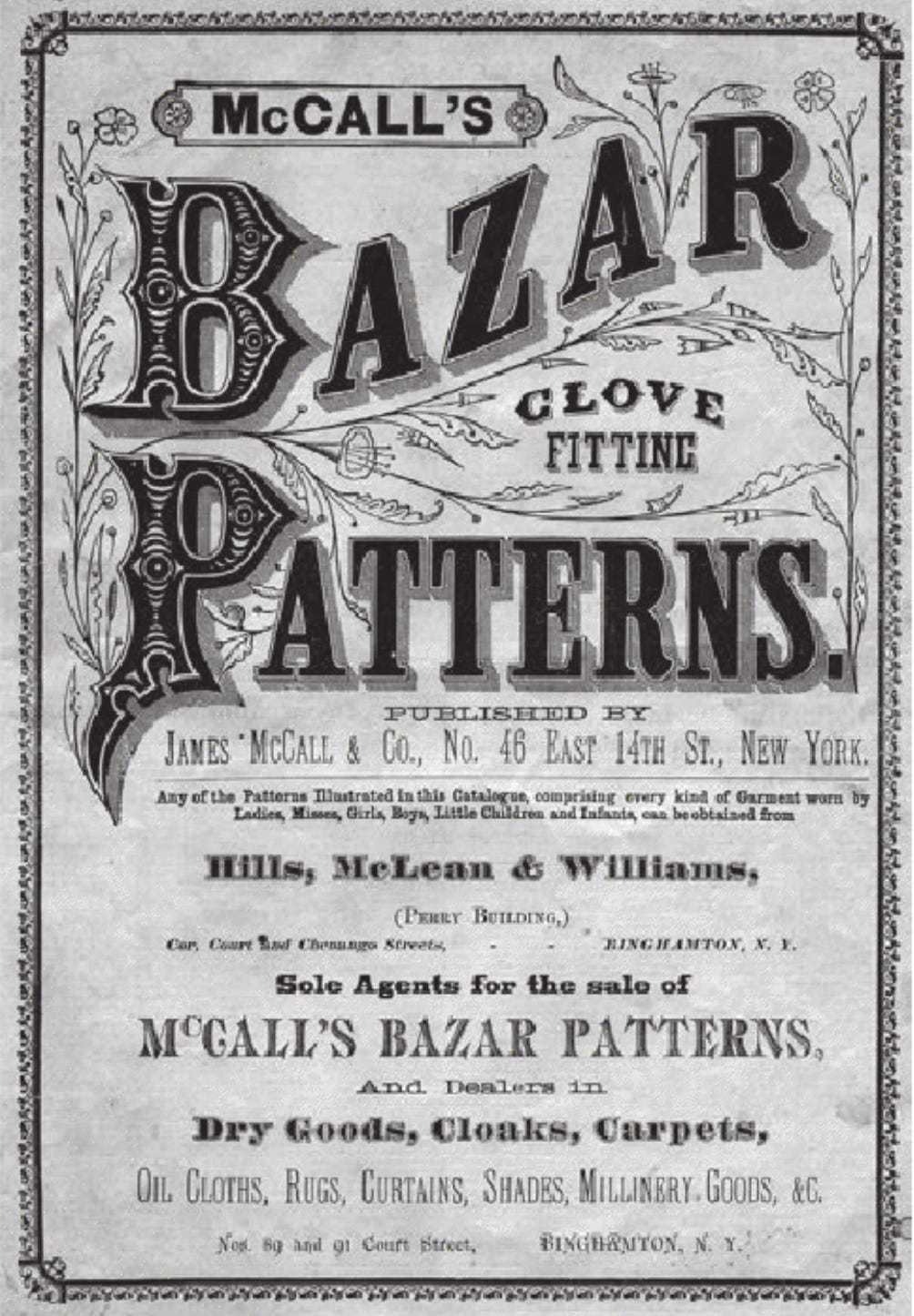
By the early 1870s, the paper pattern field was crowded. Demorest, Butterick, McCall’s, Harper’s (published by the owners of Harper’s Bazar) and S.T. Taylor were all producing patterns. Most were graded to size, and production numbers were enormous. Pattern companies typically released 30 to 40 new designs each month, with Butterick producing up to 1,000 styles a year by the 1890s. Clearly, the demand for sewing patterns was very much there!
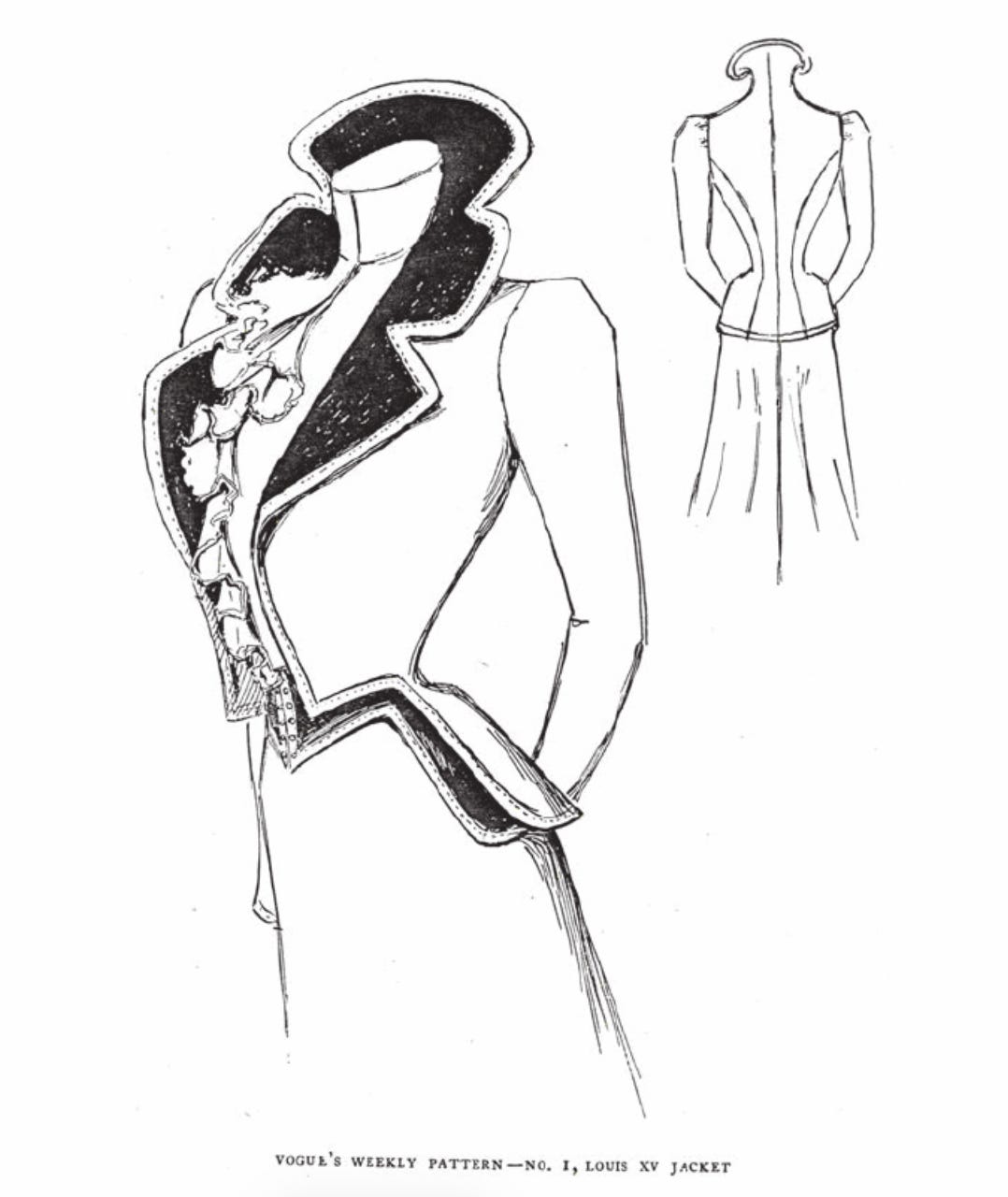
Vogue Patterns entered the scene slightly differently. That’s because the periodical (Vogue magazine) existed before the pattern division was formed. Vogue started publishing in 1892 as a society weekly. Their first pattern, a ‘Louis XV jacket’, was introduced in 1899. When Condé Nast acquired Vogue in 1909, Vogue’s pattern division was an established part of the brand.
The rise of the ‘Big 4’
By the early twentieth century, a few major players dominated the market. Butterick expanded aggressively, acquiring other companies and merging their publications. McCall’s and Vogue grew steadily. Meanwhile, some earlier competitors faded away. Demorest stopped producing patterns when Ellen Demorest retired in 1887, and others followed.
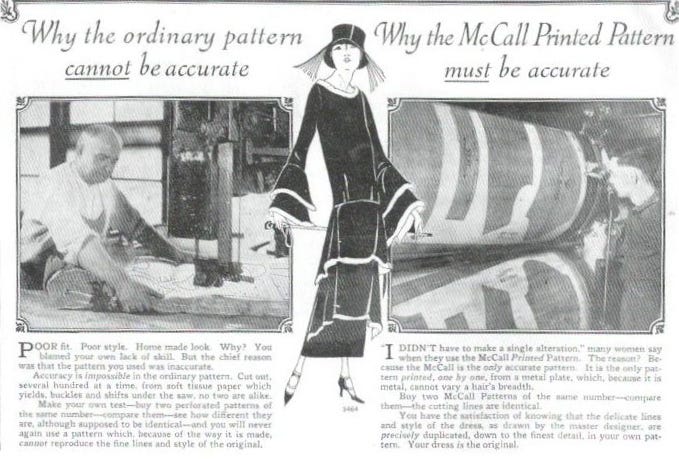
Simplicity entered the market in 1927, founded by Joseph M. Shapiro with the goal of offering the most affordable patterns possible, priced at just 15 cents. When the Wall Street crash of 1929 left many people with little money to spare, this low-cost approach proved especially effective. The brand’s affordability helped it thrive during difficult economic times, attracting customers who needed to be careful with their spending.
Simplicity also used clever marketing to present its patterns as easier to use than those of its competitors. Although this claim was not entirely accurate (Vogue were the only pattern company with consistently intricate patterns), it made the company particularly appealing to beginners and helped it grow in both size and influence.
Another major development was the legitimisation of copying designs. Pattern companies had long sent representatives to Paris to sneakily sketch couture collections. But in 1925, McCall’s began licensing designs from couture houses. This licensing trend continued into our modern era. That’s the reason why you can buy Project Runway or Disney Princess patterns from Simplicity, Laura Ashley from McCalls, or Diane Von Furstenberg or Badgley Mischka from Vogue.
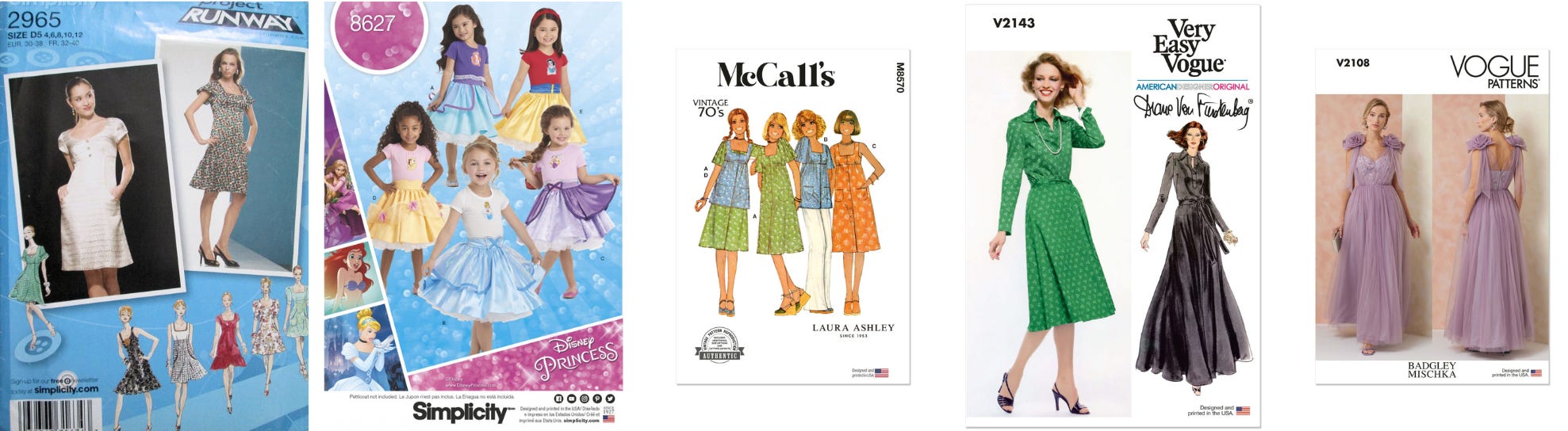
By 2001, the landscape shifted again when McCall’s acquired Butterick and Vogue (which had already merged decades earlier). The brands were repositioned with Butterick as “Classical”, McCall’s as “Contemporary”, and Vogue as “Couture”. Alongside them, companies like Burda and Kwik Sew continued to operate, and the internet opened the door to independent pattern designers.
In 2017, the Big 4 were finally consolidated under one owner. CSS Industries acquired McCall’s and its subsidiaries in December 2016, and Simplicity and its subsidiaries (they acquired New Look in 1987) in November 2017. They were consolidated into one company, Simplicity Design Group. CSS Industries (which owned Simplicity Design Group) was then acquired by the private equity firm IG Design Group in January 2020.
All this chat about mergers and acquisitions might seem dreadfully dull/confusing/irrelevant, but I promise that they were incredibly significant to what happened in 2025…
The current paper pattern landscape…
Today, the sewing pattern industry is evolving once again. Independent designers have emerged as the most significant competition to the Big 4, while the internet has made sewing more accessible than at any point in the past. Beginners can now turn to free tutorials, blogs, and online communities for guidance, and the rise of PDF patterns means that access is no longer limited by proximity to a physical shop.
At the same time, indie designers are using social media to build genuine relationships with their audiences, often shaping their designs in response to the preferences and feedback of the people who sew them.
Meanwhile, the traditional pattern giants have had a tougher time keeping up.
As Vogue, Butterick, McCall’s, and Simplicity were all brought under one corporate umbrella, the paper pattern model began to feel a bit bloated. Constant sales made the envelope price seem almost meaningless, and selling mainly through physical stores put distance between the companies and the people actually sewing their patterns.
The Big 4 were also slow to adapt to changing needs, especially around sizing and new technology, which opened the door for indie designers to step in and serve a wider range of bodies and skill levels.
Things came to a head in May 2025 when IG Design Group announced that they were selling the Big 4 brands to a liquidator for just $1. This decision came following a mix of pressures, including tariffs, a slowing market, and the bankruptcy of Joann’s.
For a moment, it looked like the end of an era. But the Big 4 were saved at the last minute by former Simplicity executive Abbie Smalls. She was able to buy Simplicity Creative group by securing funding from a different private equity firm, Rubelmann Capital.
It’s still early days, but this whole story seems like a corporate fairytale. Through her love for the company and a whole lot of determination, Smalls managed to save the Big 4 for us all!
The plan for the Big 4 now is to invest in growth, including newer formats like projector patterns, while continuing to produce the paper patterns many sewists still rely on. And that paper pattern loyalty is real!
While doing research for this essay, I came across this hilarious quote from Lisa Woolfolk of Black Women Stitch, who shared that, “I was so concerned about losing access to paper patterns… Taping PDF patterns together is hazardous to my health. It reduces my will to live. I would rather mop the ocean than do that.” Thank you Lisa for putting the horrors of taping together PDF patterns into words. I relate to this on a deeply spiritual level.
(Quote sourced from Grace Dobush, “Sewing Patterns Rise from DGA Bankruptcy Ashes”, Craft Industry Alliance.)
Despite decades of predictions that home sewing would disappear, it’s proved surprisingly resilient. If anything, it’s thriving.
Today’s pattern world is a mix of old and new, where legacy brands and indie designers exist side by side, and where the craft is continuing to evolve without losing its roots.
A postscript on sewing, gender and how we value labour
Pattern companies have never just sold instructions for making clothes. They have sold ideas about what sewing means and who it is for. At different moments in history, home sewing has been framed as a feminine duty, a moral virtue, a sign of thrift, and later as a pleasant, creative pastime.
That framing carries weight. Sewing has long occupied an uneasy space between work and leisure, production and pleasure. It requires skill, time, patience, and physical effort, yet it has rarely been recognised as labour in the same way as other forms of making are.
Although both men and women have historically worked as professional tailors and dressmakers, sewing in the home became closely tied to women’s unpaid domestic roles and was treated as something expected rather than something valued.
In recent years, the meaning of sewing has shifted again. Within slow fashion spaces, making your own clothes is often presented as a feminist and ethical act, a form of resistance to fast fashion and mass production. While that reframing has helped elevate the cultural importance of sewing, it also risks keeping it in the realm of ‘hobby’ or personal virtue. The skill, knowledge, and labour involved can still be softened or overlooked, just under a different set of ideals.
The paper pattern industry has always depended on women’s expertise and effort, even when that work was minimised or taken for granted. And that raises a bigger question: when something is associated with the home, with women, or with pleasure, why do we find it so easy to stop seeing it as real labour?
Learn more!
So much of this knowledge is thanks to Joy Spanabel Emery, whose meticulous research has uncovered the hidden history of commercial patterns.
She spent decades collecting, cataloguing, and analysing thousands of patterns. By founding the Commercial Pattern Archive and pioneering research into this overlooked corner of fashion history, she brought long-ignored material into the academic spotlight and ensured it would be preserved and studied for generations to come.
This was only a brief overview, so to learn more, you should really read Joy’s book: A History of the Paper Pattern Industry: The Home Dressmaking Fashion Revolution. It was my primary source for this newsletter, and an absolutely invaluable resource for anyone who cares about the history of sewing patterns!

If you enjoyed this, you might also like…
Are dupes democratising fashion?

In the past few years, “dupe culture” has exploded. Everywhere I look on social media, someone is lauding the dupe they got for $20 off Amazon, which, if they’d bought the original, would have cost $200.
Is this sewing pattern breaking the law?

How ethical is it to make and buy sewing patterns based on ready-to-wear clothing? Are sewing ‘dupes’ any better than SHEIN ripping off a small designer? Or is it a completely different issue and I’m overthinking all of this?
Why you should be spending more on clothes

In a world of $10 T-shirts and next-day delivery, we expect clothing to be cheap, fast and replaceable. Fast fashion has trained us to buy impulsively, cycle through styles at a dizzying pace, and assume it’s normal to discard a piece of clothing after just a handful of wears.
I enjoyed and learned a lot from this post Sarah. All so interesting, but Lisa Woolfolk's comment takes the cake! Brilliant, hilarious, and I concur- although I loathe cutting out those flimsy tissue paper patterns too. Cutting out {and this includes fabric), printing, and sticking together is the only part of the sewing process I hate. Like REALLY. HATE!!!
Great article! I just finished reading Claire Hunter’s book, Threads of Life: a History of the World through the eye of a needle. Lots more interesting history of sewing and particularly of the role of sewing and needlework in defining women’s roles in society. Super interesting and a good read!